How to close a deceased person's Fidelity account
Fidelity handles closing a deceased person's account through an online form or by phone. The steps below are Fidelity's own published process, taken from the provider's official support pages. HeirLoft organizes the steps to show what the provider asks for, without adding to the process or recommending any action.
- Ways to start
- Online form · Phone
- Phone
- 800-544-0003
- Documents listed
- Provided when you contact it
- Published timeline
- Not published
- Official sources
- 2 pages, verified 2026-09-14
What documents does Fidelity ask for?
The provider will tell you which documents it needs when you contact it.
How do you close a deceased person's Fidelity account?
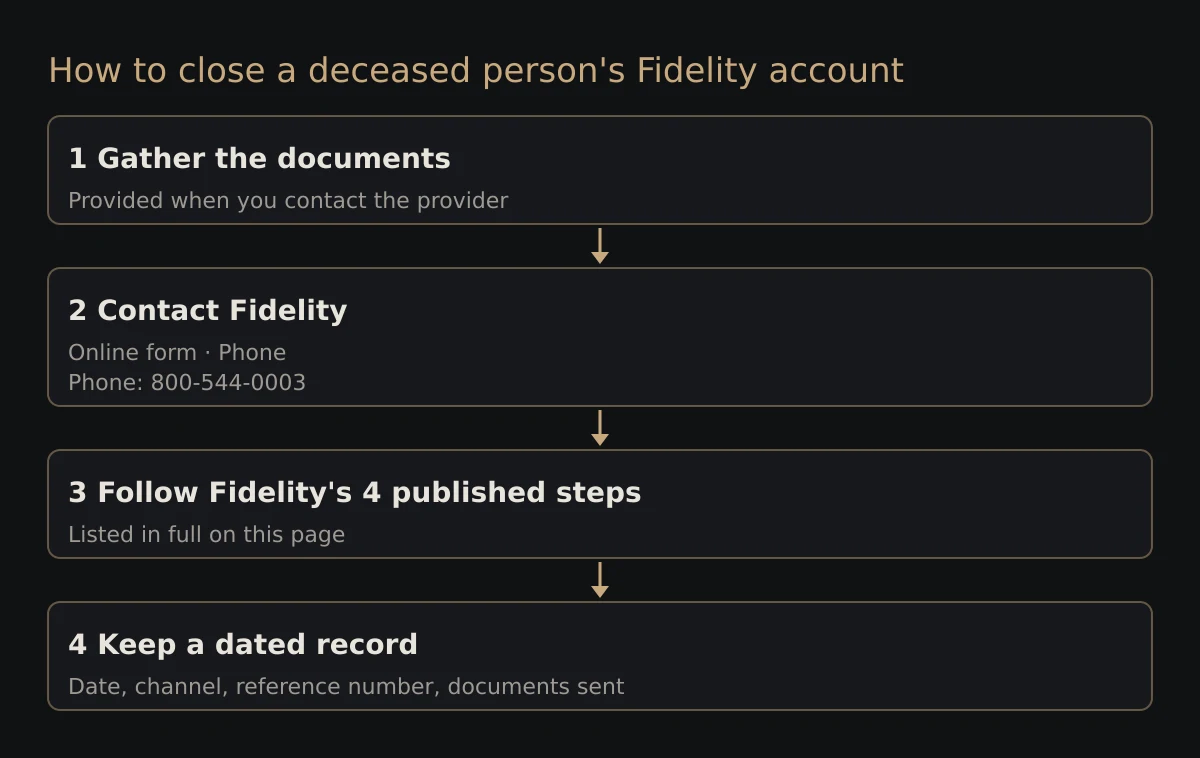
Fidelity handles a deceased person's account through an online form or by phone. The published steps, in order:
- Notify Fidelity of the death online — you won't need death certificates or account numbers to start.
- Fidelity's guided 3-step inheritance process then walks you through inheriting the assets, whether you are a beneficiary or someone authorized to act on the estate's behalf.
- For an inherited IRA, call 800-544-0003 to begin; for workplace plans (401(k), 403(b), 457) call 800-835-5095; for annuities or life insurance, contact the issuing company first (Fidelity help: 800-544-4374).
- For non-retirement accounts (brokerage, cash management, trusts), Fidelity guides you through your inheritance options after the death notification.
Closing one account is only part of the job — every recurring charge still draws on a card or bank account the estate will eventually claim. HeirLoft reads the recurring charges out of an Outlook inbox, or a Gmail export, in one pass. You can see everything that's still billing while you work down the list.
Surface every recurring charge in one place
How do you contact Fidelity?
Start from Fidelity's official page for deceased accounts, or call 800-544-0003.
- Fidelity's official page for deceased accounts
- Phone: 800-544-0003
How long does Fidelity take?
Fidelity does not publish a typical timeline for closing a deceased person's account. Keep a dated log of each request so you can follow up with the reference number.
Notes
Fidelity publishes an Inheritance checklist and executor/trustee guidelines alongside the notification flow.
How a Fidelity account passes after a death
Whether the money in a Fidelity account goes through the estate depends on how the account was set up. The answer can differ from one account to the next within the same estate.
- Access is a claim, not a login. Fidelity verifies the death and your authority, then acts on the account — nobody takes over the deceased's online access. Using their card, PIN, or login, even to pay a legitimate bill, can violate the account agreement and the law; bills that must be paid are handled through the estate.
- Payable-on-death or transfer-on-death — generally no probate. An account with a POD or TOD beneficiary passes directly to the named person, who claims it with a certified death certificate and ID.
- Joint with right of survivorship — usually no probate. Ownership typically continues with the surviving co-owner, who notifies the institution so the account can be retitled. An account in the deceased's name alone is a different case.
- Everything else — through the estate. The executor or administrator claims it once appointed, usually with letters testamentary. Many states offer a small-estate affidavit for modest accounts; thresholds and waiting periods vary by state. A power of attorney ends at death, so an agent under one can no longer act.
- Cancel recurring charges at the source first. When a card or bank account stops working, the subscriptions billed to it fail — but they are not formally canceled, and some companies keep trying to collect. Surfacing and canceling them before the account closes is cleaner than relying on a closed account to stop them.
Keep a record as you go
Each provider runs a separate process on a separate schedule, so the work goes faster with a simple log. For every contact with Fidelity, note the date and the channel you used. Record the name or ID of the person you dealt with, any case or reference number, and which documents you sent.
Some providers accept a legible photocopy of the death certificate and others insist on a certified copy, so order several certified copies early rather than one at a time. An organized record protects you as executor and makes the estate's accounting cleaner.
Frequently asked questions
Can I contact Fidelity by phone?
Yes — Fidelity lists 800-544-0003 for this process. Other routes it lists: online form.
Can I sign in with their password and close it myself?
No — use Fidelity's official process. Signing in with the deceased person's password, even if you know it, is generally against the provider's terms and may be unlawful.
How can I spare my own family this process?
Leave a clear list of what exists and what you want done with each account — a record of decisions, not passwords — somewhere your family can find the list. How to leave a list of your accounts for your family
Sources
- https://www.fidelity.com/wealth-management/inheritance/overview
- https://www.fidelity.com/learning-center/life-events/loss-of-loved-one
Last reviewed September 14, 2026 · Links verified September 14, 2026
Related guides
- Close a deceased person's account, provider by provider
- Accessing a deceased person's financial accounts
Closing Fidelity is one account. If the estate has several, the HeirLoft Executor Kitputs every provider's documents, contact route and published steps into one PDF, with a written-cancellation letter template and a tracking sheet for dates and reference numbers. One payment of $29, no account to create.
The simplest way to spare your own family the closure process is to keep an up-to-date list of your accounts somewhere your family can find the list. HeirLoft finds the recurring charges you've forgotten and keeps them in one place your heirs can actually use.